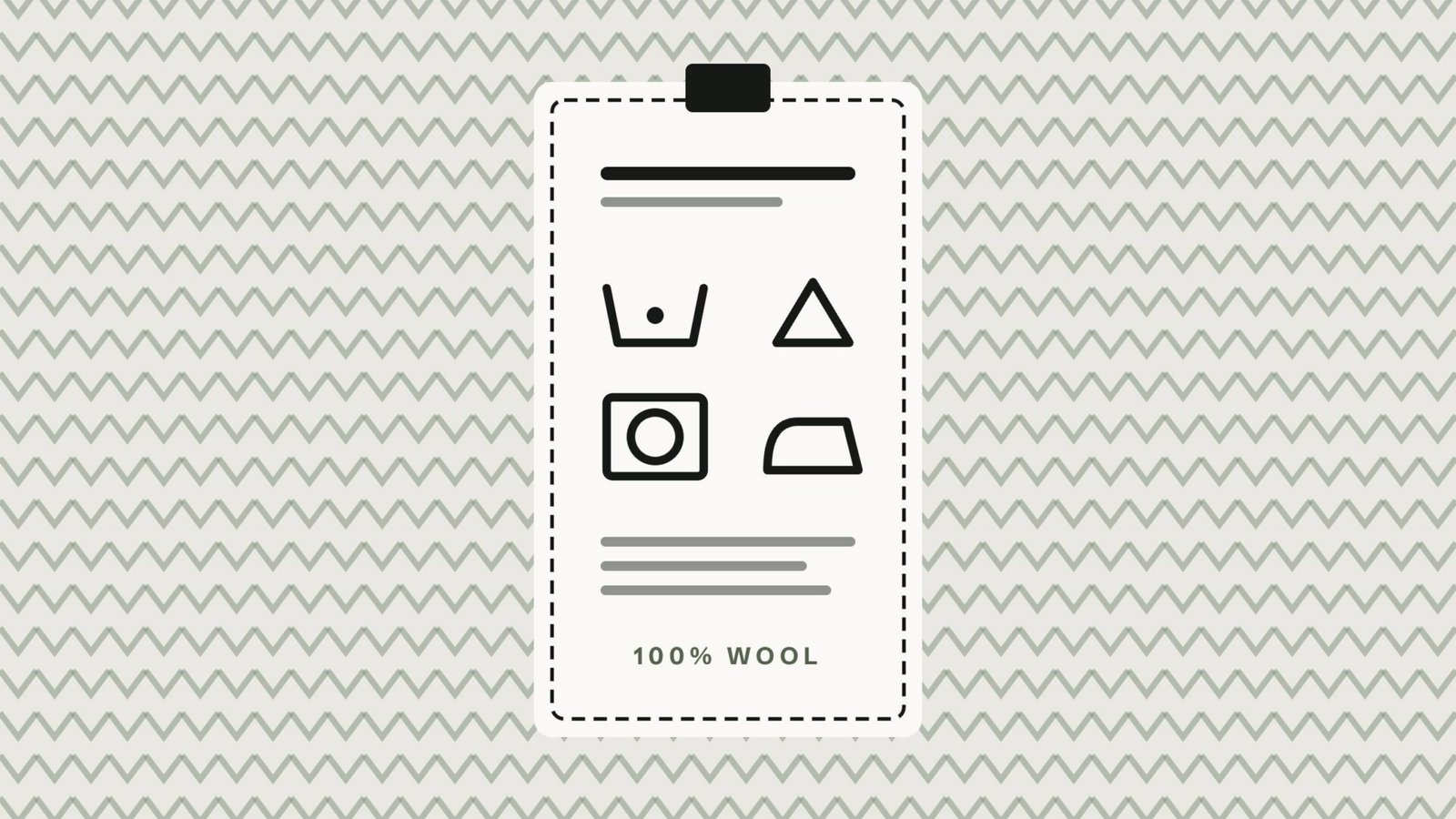
Almost every clothing care label is built around five basic symbols: a washtub for washing, a triangle for bleaching, a square for drying, an iron for ironing, and a circle for professional cleaning.
These symbols tell you how to care for your clothes without damaging the fabric. Numbers indicate washing temperatures, dots show heat levels in certain symbols, lines indicate gentler processes, and a cross means the indicated treatment should not be used.
Once you understand these basic rules, reading most clothing care labels becomes much easier. This guide explains what each symbol means, how to avoid common laundry mistakes, and why care labels can differ between countries.
The Five Basic Clothing Care Symbols
1. Washing: The Washtub
The washtub symbol tells you whether a garment can be washed at home and which washing conditions are recommended.
Here is how to read the main washing symbols:
- A number inside the tub: Indicates the maximum washing temperature in degrees Celsius. For example, 30 means the water temperature should not exceed 30°C.
- One line beneath the tub: Indicates a milder washing process with reduced mechanical action.
- Two lines beneath the tub: Indicates a very gentle washing process, often suitable for delicate or wool garments.
- A hand inside the tub: Indicates hand washing.
- A crossed-out tub: Means the garment must not be washed using the indicated domestic washing process.
The temperature shown is a maximum, not a requirement to wash at that exact temperature. A lower temperature may be suitable if the garment’s other care instructions allow it.
Example: A washtub marked 30°C with two lines underneath indicates a maximum washing temperature of 30°C and a very gentle washing process.
2. Bleaching: The Triangle
The triangle indicates whether bleach can be used on a garment.
- An empty triangle: Any type of bleach is permitted under the symbol system.
- A triangle with two diagonal lines: Only non-chlorine bleach should be used when needed.
- A crossed-out triangle: Do not bleach the garment.
Bleach can damage dyes, weaken fibres, or change the appearance of certain fabrics. Always check this symbol before adding bleach to your laundry.
If the label permits only non-chlorine bleach, choose a suitable oxygen-based product and follow its instructions. Do not assume that every product marketed as a stain remover is safe for every fabric.
3. Drying: The Square
The square represents drying. Its additional markings tell you whether tumble drying or a particular natural drying method is appropriate.
Tumble drying
A circle inside the square indicates tumble drying.
- One dot inside the circle: Use a low-heat tumble-drying setting.
- Two dots: Use a normal-heat tumble-drying setting.
- Three dots: Indicate a higher-heat setting where supported by the applicable symbol system.
- A crossed-out square containing a circle: Do not tumble dry.
Always follow the actual symbol on your garment, as the permitted temperature and available settings depend on the applicable care-labelling system.
Natural drying
Lines and other markings inside the square indicate different natural drying methods.
- A vertical line: Line drying.
- Two vertical lines: Drip drying.
- A horizontal line: Drying flat.
- Two horizontal lines: Drip drying flat.
- An additional diagonal line: Drying in the shade when shown in the relevant combination.
These instructions are particularly useful for garments that may stretch, lose their shape, or become damaged in a tumble dryer.
For example, a knitted jumper marked for flat drying should be laid flat rather than hung while wet, which can cause it to stretch.
4. Ironing: The Iron
The iron symbol tells you whether ironing is permitted and how much heat the garment can tolerate.
- One dot: Low-temperature ironing, suitable for heat-sensitive fabrics.
- Two dots: Medium-temperature ironing.
- Three dots: High-temperature ironing, where permitted by the care label.
- A crossed-out iron: Do not iron.
- A crossed-out steam marking, where present: Do not use steam.
Under the international symbol system, the familiar temperature ranges are approximately:
| Iron symbol | Maximum soleplate temperature |
|---|---|
| One dot | 110°C |
| Two dots | 150°C |
| Three dots | 200°C |
These are maximum temperatures, not instructions to iron every garment at that setting.
Synthetic fabrics may require low heat, while some cotton and linen garments tolerate higher temperatures. However, the garment’s label takes priority over general fabric advice.
If you are unsure, start with a lower setting and check the manufacturer’s instructions.
5. Professional Cleaning: The Circle
The circle represents professional textile care, including dry cleaning and professional wet cleaning.
Letters and additional markings provide instructions for the professional cleaner.
- A circle containing P: Indicates a permitted professional dry-cleaning process using the solvents and conditions specified by the applicable symbol system.
- A circle containing F: Indicates a different permitted dry-cleaning process with specified solvent requirements.
- A circle containing W: Indicates professional wet cleaning.
- A crossed-out circle: Do not use the indicated professional dry-cleaning process.
The letters are not instructions for washing clothes at home. They help professional cleaners select an appropriate process.
If your garment carries a professional-cleaning symbol and you are unsure what it means, show the label to your dry cleaner before choosing a treatment.
What Does an X Through a Clothing Care Symbol Mean?
A cross through a care symbol means the indicated treatment must not be used.
For example:
- A crossed-out washtub means do not wash.
- A crossed-out triangle means do not bleach.
- A crossed-out tumble-drying symbol means do not tumble dry.
- A crossed-out iron means do not iron.
- A crossed-out professional-cleaning circle means do not use the indicated cleaning process.
The cross applies to the symbol it modifies. It does not automatically mean that every possible cleaning method is prohibited.
For instance, a garment marked as unsuitable for domestic washing may still have instructions permitting professional cleaning. Always read the complete label rather than interpreting one symbol in isolation.
Common Clothing Care Labels Explained
Different fabrics require different care methods. The following examples show how to apply the symbols when looking after everyday clothing.
Wool Jumper
Wool garments can shrink, stretch, or lose their shape when washed incorrectly.
Check whether the label permits machine washing or requires hand washing. If the washtub has two lines beneath it, select a very gentle cycle and follow any additional wool-care instructions.
If the label specifies flat drying, place the jumper on a suitable flat surface instead of hanging it while wet.
Cotton T-Shirt
Many cotton T-shirts can be machine washed, but the permitted temperature depends on the garment’s construction, dye, and finishing.
Check the maximum washing temperature, bleach symbol, tumble-drying instructions, and ironing temperature before washing.
A printed or coloured T-shirt may require gentler care than a plain white cotton garment.
Polyester Jacket
Polyester garments often tolerate lower washing temperatures, but linings, coatings, padding, and other components can change the recommended care method.
Follow the label’s washing and drying instructions. Avoid applying high heat unless the label permits it.
Silk or Viscose Blouse
Silk and viscose garments may be sensitive to friction, moisture, heat, or stretching.
Check whether the label permits hand washing or requires professional cleaning. If a gentle washing process is allowed, avoid rough handling and follow the specified drying instructions.
Do not assume that every silk or viscose garment can be washed at home.
Jeans
Many jeans can be machine washed, but the appropriate temperature and drying method depend on the fabric, dye, and any stretch fibres.
Follow the manufacturer’s instructions, separate colours when necessary, and check the label before using bleach or a tumble dryer.
These examples are general guidance. The symbols on the actual garment should determine its care routine.
Why Clothing Care Labels Differ Between Countries
Care labels are not completely identical around the world. Different markets may use different standards, and the rules governing which instructions manufacturers must provide also vary.
United States
The US Federal Trade Commission (FTC) enforces the Care Labeling Rule, which requires manufacturers and importers to provide care instructions for most covered textile clothing.
The rule permits written instructions and, under the applicable requirements, recognised care symbols. The US has historically used ASTM care-symbol standards that differ in some respects from the international ISO system.
As a result, an American label may include written instructions or symbols that look slightly different from those commonly found on European clothing.
The FTC also requires manufacturers to have a reasonable basis for their care instructions. For example, a garment should not be labelled “Dry Clean Only” without a reasonable basis for warning consumers against washing it.
Source: FTC — Clothes Captioning: Complying with the Care Labeling Rule.
UK, Europe and Other Markets
The international standard ISO 3758:2023 establishes a system of graphic symbols for textile care labelling. It covers washing, bleaching, drying, ironing, and professional care.
GINETEX, the international association associated with the familiar care-symbol system, provides guidance on interpreting these symbols.
Although the international system is widely used, labelling requirements and enforcement arrangements vary by country.
Sources: ISO 3758:2023 and GINETEX Care Symbols.
Canada
In Canada, care labelling is generally voluntary under federal textile-labelling rules. However, if a supplier provides care information, it must not be false or misleading and must accurately describe an appropriate method of care.
Written instructions may be provided in English or French, and additional language requirements apply in Quebec.
Source: Competition Bureau Canada — Textile Labelling Requirements.
Australia
Australia has a mandatory care-labelling standard for covered clothing and textile products.
The standard allows care instructions to be provided in English, through the five internationally recognised care symbols, or through both methods.
It applies to many clothing and household textile products, although specific exemptions exist.
Source: Australian Competition and Consumer Commission — Care Labelling Standard.
When Should You Follow the Care Label Exactly?
Following the manufacturer’s care instructions is generally the safest way to avoid damaging a garment.
This is especially important for wool, silk, leather, delicate fabrics, coated materials, and clothing marked for professional cleaning.
There is also a difference between “Dry Clean” and “Dry Clean Only”. Under the US FTC guidance, “Dry Clean Only” indicates that the garment cannot safely be washed, while a dry-cleaning instruction without “Only” does not necessarily rule out other safe cleaning methods.
Do not assume that this distinction works identically under every country’s labelling system. Read the full instructions and check the applicable standard if you are unsure.
If you choose a treatment that differs from the label, you may risk shrinkage, colour loss, fabric distortion, or other damage. Testing a hidden area may help reveal some problems, but it cannot guarantee that the entire garment will remain undamaged.
Quick Checklist Before You Wash
Before putting your clothes in the washing machine, take a few seconds to check the label.
- Check the washtub: Confirm whether washing is permitted, the maximum temperature, and the required cycle.
- Check the triangle: Make sure bleach is allowed before using it.
- Check the square: Confirm whether tumble drying is permitted and whether natural drying is required.
- Check the iron: Use an appropriate temperature and avoid steam if prohibited.
- Check the circle: Follow any professional-cleaning instructions.
- Separate laundry appropriately: Sort garments by colour, fabric, and care requirements.
- When in doubt, choose caution: A cooler temperature or gentler process may reduce risk when permitted by the garment’s instructions.
Frequently Asked Questions
What are the five basic clothing care symbols?
The five basic symbols are the washtub for washing, triangle for bleaching, square for drying, iron for ironing, and circle for professional cleaning.
What does 30°C mean on a clothing label?
A number of 30 inside the washtub means the maximum washing temperature is 30°C. It does not mean that you must wash the garment at exactly 30°C.
What does one dot mean on a care label?
The meaning depends on the symbol. Inside an iron, one dot indicates low-temperature ironing. Inside the tumble-drying symbol, one dot indicates low heat. For international ISO washing symbols, the maximum temperature is generally shown as a number inside the tub.
Can I tumble dry clothes with a crossed-out square?
If the square contains a crossed-out circle, the garment must not be tumble dried. Check whether the label specifies a natural drying method instead.
What does P or F mean inside a circle?
These letters provide information about the permitted professional dry-cleaning process, including the relevant solvent requirements. They are intended for professional cleaners rather than for home laundry.
Do all countries use the same clothing care symbols?
No. The international ISO system is widely used, but some markets have different standards or labelling requirements. The United States has historically used ASTM care symbols, while other countries may accept international symbols, written instructions, or both.
Can I ignore a clothing care label?
You can choose how to care for your clothes, but ignoring the manufacturer’s instructions increases the risk of damage. For expensive or delicate garments, follow the label or consult a professional cleaner.
Final Thoughts
Clothing care labels may look confusing at first, but learning the five basic symbols makes laundry easier and helps you avoid common mistakes.
Remember the washtub, triangle, square, iron, and circle. Check temperatures, pay attention to lines and dots, and never ignore a crossed-out symbol.
Most importantly, read the complete label before washing, drying, ironing, or arranging professional cleaning. A few seconds of checking can help your clothes last longer and keep them looking their best.
Sources and Further Reading
- GINETEX — Care Symbols
- ISO — ISO 3758:2023 Textiles: Care Labelling Code Using Symbols
- US Federal Trade Commission — Care Labeling Rule
- Competition Bureau Canada — Textile Labelling Requirements
- Australian Competition and Consumer Commission — Care Labelling Standard
RAZIUN publishes practical guides to everyday technology, consumer information, and useful skills. Always follow the instructions on your own garment when choosing a care method.
Comments